
Color Blindness Test — Free Online Ishihara Test
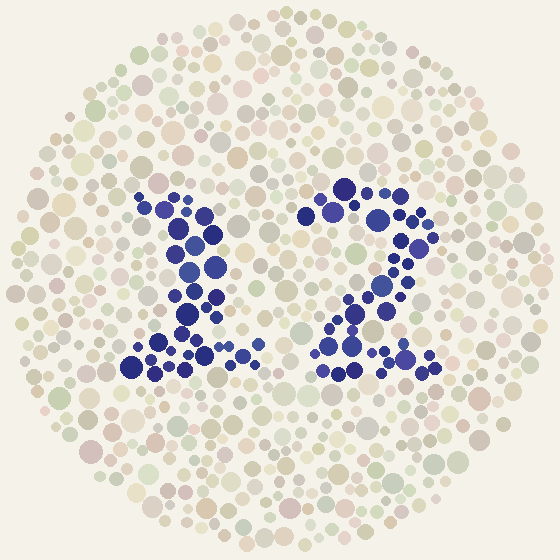
This color vision test screens for red-green color blindness using 8 Ishihara-style dot plates. Type the number you see in each plate — if you can't see one, that's an answer too.
What is color blindness?
Color blindness — more precisely, color vision deficiency — means some cone cells in the retina respond to light differently than usual, making certain colors hard to tell apart. Red-green color blindness is by far the most common form and is usually inherited; according to theNational Eye Institute, it affects roughly 1 in 12 men and 1 in 200 women, and most people with it lead completely normal lives.
How this test works
Each plate is a disc of colored dots with a number drawn in hues that sit on a red-green confusion line — visible through hue contrast, not brightness. With typical color vision the number stands out; with a red-green deficiency it blends into the background. The first plate is a control that everyone should see. Our plates are original, generated in the Ishihara style — the classic clinical set has 38 plates, and this 8-plate screen follows the same principle.
Your result suggests — what next?
Missing one red-green plate can be screen calibration; missing several is a meaningful signal of a color vision deficiency and worth confirming with a clinical color deficiency test. Many driving-license, army and aviation screenings use supervised Ishihara plates, so if you're testing ahead of an application, treat this as practice — the official exam must be done in person.
Frequently asked questions
What is the Ishihara color blindness test?
The Ishihara test is the most widely used screening test for red-green color blindness. It shows circular plates made of colored dots with a number hidden inside; people with normal color vision see the number, while those with red-green color vision deficiency see a different number or none at all.
How accurate is an online color blindness test?
An online color blindness test is a useful first screen but not a diagnosis. Screen color calibration, brightness and ambient light all shift the colors, so results can differ from a clinical test with printed plates — if this test suggests a deficiency, confirm it with an eye-care professional.
What are the types of color blindness?
The main types are red-green (protan and deutan — by far the most common), blue-yellow (tritan — rare), and total color blindness (achromatopsia — very rare). Red-green color vision deficiency affects roughly 1 in 12 men and 1 in 200 women.
Can color blindness be cured or corrected?
Inherited color blindness has no cure. Special filter glasses (such as EnChroma) can enhance contrast between some colors for some people with red-green deficiency, but they do not restore normal color vision.
Do I need this test for a driving license or job application?
Many countries screen color vision for driving licenses, military service, aviation, rail, police and electrical work. This online version is fine for practice and self-checking, but official applications require a supervised clinical test — check your local authority’s requirements.
How many Ishihara plates are in the full test?
The complete clinical Ishihara test has 38 plates; common short versions use 24 or 14. This online screening uses 8 original Ishihara-style plates, which is enough to flag a possible red-green deficiency.
How this test works: everything runs and is timed locally in your browser, and results depend on your device and conditions. Scores are for casual benchmarking and entertainment — not a clinical, medical or diagnostic measurement.